Table of Content

Roulette Online: Rules, Bets, Strategy and Live Dealer Play

Last updated: July 2026

Roulette is one of the most recognisable casino games in the world. A spinning wheel, a bouncing ball, a table covered in betting options. Whether you first saw it in a land-based casino, a live-dealer stream, or a free browser demo, the appeal comes down to elegant simplicity and a surprisingly wide range of wagers.

This guide covers every aspect a player should understand before placing a single chip: the rules and equipment, every bet type with its exact payout, the mathematics of house edge and odds, popular betting strategies (and the myths around them), modern live and RNG formats, the path from demo play to real money, and the responsible-gambling principles that should shape every session.


Roulette Online Rules, Bets, Strategy and

Disclaimer: Roulette is a game of chance with a negative mathematical expectation for the player. No strategy or system can guarantee profit over time. This article is for educational and entertainment purposes only. If you or someone you know shows signs of problem gambling, please contact a helpline such as BeGambleAware (begambleaware.org) or the National Council on Problem Gambling (ncpgambling.org).

What Roulette Is and How the Game Works

Roulette originated in France during the 18th century. The name itself means "little wheel." Over three centuries it evolved from a parlour curiosity into a cornerstone of every major casino floor and online gambling platform. Today it exists in multiple variants, but the core mechanic has never changed: a numbered wheel spins, a ball is released in the opposite direction, and players bet on where the ball will come to rest.

That simplicity is deceptive, though. Behind it sits a precise mathematical structure that governs every payout, every probability, and every cent the casino earns.

The Objective of the Roulette Game

The primary objective for the player is to correctly predict the pocket where the ball will settle after each spin. Each pocket is identified by number and colour. The roulette game is structured so that every possible wager carries a built-in mathematical disadvantage for the player, known as the house edge, which manifests as a steady leakage of value from player bankrolls to the casino over time.

Here is the fundamental principle that governs all roulette payouts: an inverse relationship between probability and reward. The less likely a bet is to win, the higher its payout, and vice versa. A straight-up bet on a single number pays 35:1 but wins only once every 37 spins on average in European roulette. Betting on red or black pays just 1:1 but wins close to half the time. In both cases, however, the payout is set slightly below the true mathematical odds. That gap is the casino's profit margin.

The Objective of the Roulette Game

The SOCR roulette simulation demonstrates that regardless of bet type, the long-term result reflects the casino's built-in edge. - SOCR Roulette Experiment, University of Michigan. https://www.socr.umich.edu/html/exp/index.html

Understanding this structure is essential for anyone exploring the broader iGaming landscape, where roulette sits alongside slots, blackjack, and sports betting as one of the most widely played products.

Roulette Wheel, Table and Game Round

A standard roulette setup, whether physical or virtual, consists of several key components:
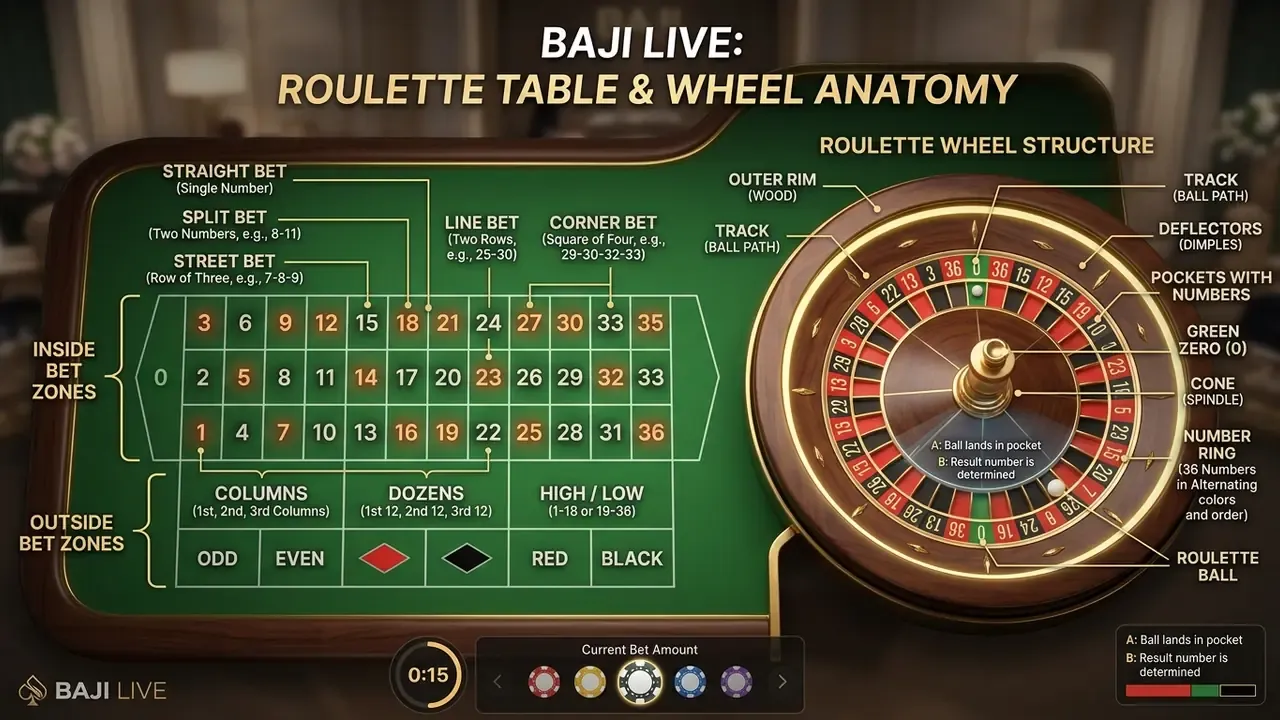
  • The Roulette Wheel:A precision-engineered disc with numbered pockets arranged around its circumference. The European wheel has 37 pockets (numbers 1 to 36 plus a single green zero), while the American wheel has 38 pockets (adding a green double zero, 00).
  • The Roulette Table Layout:A felt or digital grid where all bet types are represented. The inner grid contains individual numbers in alternating red and black squares. Surrounding zones mark outside bets: red/black, odd/even, high/low, dozens, and columns.
  • The Ball:Traditionally ivory, now typically nylon, phenolic, or moulded acetal. The croupier (or automated mechanism) launches it along the wheel's track in the opposite direction to the spin.
  • Chips:Used to place wagers on the layout. In a live casino, each player typically receives uniquely coloured chips to avoid disputes.
  • The Marker (Dolly):After the ball settles, the dealer places a marker on the winning number. No bets may be touched until the marker is removed.
  • The Rake:The tool croupiers use to collect losing chips and distribute winnings.
Roulette Wheel, Table and Game Round

Every roulette round, whether at a physical table or in a live-streamed online session, follows the same chronological sequence:

  1. "Place your bets" (Faites vos jeux): The dealer opens the betting window. Players position chips on the layout.
  2. Spin and launch: The dealer spins the wheel in one direction and sends the ball in the other.
  3. "No more bets" (Rien ne va plus): As the ball begins to slow, the dealer closes the betting window. No new or adjusted wagers are accepted after this point.
  4. Result determination: The ball falls into a numbered pocket. The dealer announces the winning number and its colour.
  5. Marking and settlement: The dolly is placed on the winning number. Losing bets are collected; winning bets are paid out according to the fixed payout table.
  6. New round: The dolly is removed and betting reopens.

This single-round resolution ensures that each spin is a discrete, independent event. No information from previous rounds carries forward to influence the next outcome. That property is central to understanding roulette odds and the futility of "tracking" systems.

Because of its clear probabilistic structure, roulette is widely used in university statistics and probability courses. Simulations, including spreadsheet-based models using Excel VBA, allow students to observe how empirical averages approach theoretical expectations as the number of trials increases, illustrating the law of large numbers in a tangible format.

Every roulette round, whether at a

An Excel VBA roulette simulation allows students to watch empirical returns converge toward the theoretical expectation as the number of spins grows. - SOCR Roulette Experiment / Educational Simulation Tool. https://www.socr.umich.edu/html/exp/index.html

Roulette Rules for Beginners

Understanding every available bet, where to place chips, what numbers are covered, and what the payout is, forms the foundation of informed roulette play. Before diving into specific bet types, let us walk through the basic process that applies to every round.

How to Place a Bet and When Betting Ends

In both land-based and online roulette, all wagers must be placed before the dealer announces "no more bets." The betting window typically opens as soon as the previous round is settled and the dolly is removed. Players position chips on the roulette table layout, either on individual numbers (inside bets) or on broader outcome zones (outside bets).

Timing matters. In live dealer roulette, the window usually lasts 20 to 40 seconds. In RNG-based roulette online, you can take as long as you like before clicking "spin." Once the ball is in motion and the dealer calls the close, no new or adjusted wagers are accepted. This is a strict rule, enforced both by casino protocol and by software in digital formats.

How to Place a Bet and

Technical standards set by the Gambling Commission require that all bets and winnings be settled before a new game cycle begins. - Gambling Commission, Remote Technical Standards (RTS). https://www.gamblingcommission.gov.uk/licensees-and-businesses/guide/remote-technical-standards

How Payouts Are Determined After the Spin

Once the winning pocket is determined, the payout calculation is straightforward: each bet type has a fixed payout ratio, applied to the player's stake. A straight-up bet pays 35:1. A red/black bet pays 1:1. There is no ambiguity and no hidden calculation.

The resolution of every wager within a single spin ensures that payout calculation is transparent and that no deferred losses accumulate across spins. Regulatory oversight also encompasses fairness auditing of random number generators (RNGs) and house edge calculations. Licensed operators are typically required to have their RNG systems tested by accredited third-party laboratories, though the specific tested parameters and detailed test results may not always be published in full. The regulatory framework mandates the testing, even if transparency of individual audit reports varies by jurisdiction.

Worth noting: for players in Bangladesh and similar markets, the legal status of online gambling varies. Always verify local regulations before playing roulette for real money.

How Payouts Are Determined After the

Inside Bets and Outside Bets Explained

Roulette bets are divided into two broad families: inside bets (placed on the numbered grid) and outside bets (placed on the surrounding zones). Inside bets cover fewer numbers and pay more. Outside bets cover more numbers and pay less. The house edge, interestingly, remains the same for nearly every bet on a standard European table.

Inside Bets on the Table Layout

Inside bets are placed directly on the numbered grid. They offer higher payouts but lower probabilities:

Bet TypeNumbers CoveredWhere to Place ChipsPayoutWin Probability (European)
Straight / Single1Centre of a single number square35:12.70% (1/37)
Split2On the shared edge between two adjacent numbers17:15.41% (2/37)
Street3On the outer edge at the end of a row of three11:18.11% (3/37)
Corner / Square4On the intersection where four numbers meet8:110.81% (4/37)
Six Line / Double Street6On the outer corner shared by two adjacent rows5:116.22% (6/37)
First Four (European only)4 (0, 1, 2, 3)Corner between 0 and 1, or 0 and 38:110.81% (4/37)

Practical example, Straight bet: If you place $100 on number 7 and it hits, you receive $3,500 in winnings plus your original $100 stake back, for a total return of $3,600.

Practical example, Six Line bet: Place your chips on the rightmost or leftmost outer corner of a row of six consecutive numbers (for instance, 31 to 36). A $100 bet returns $600 ($500 winnings plus the $100 stake) if any of those six numbers wins.

The high payouts of inside bets can create a powerful psychological pull. Research on cognitive biases in gambling contexts shows that players systematically adjust bet sizes based on perceived streaks, even though each roulette outcome is entirely independent of the last.

Practical example, Straight bet If you

Outside Bets for Simpler Roulette Play

Outside bets are placed on the zones surrounding the main number grid. They cover broader outcomes and offer smaller payouts but significantly higher hit rates:

Bet TypeNumbers CoveredPayoutWin Probability (European)
Red / Black181:148.65% (18/37)
Odd / Even181:148.65% (18/37)
Low (1-18) / High (19-36)181:148.65% (18/37)
Dozens (1st 12 / 2nd 12 / 3rd 12)122:132.43% (12/37)
Columns122:132.43% (12/37)

Outside bets are widely recommended for beginners: they offer the closest to even-money odds available on the roulette table and keep session-to-session bankroll swings relatively manageable. However, the house edge applies equally to outside bets, meaning they still contribute to cumulative losses over time.

Research shows that framing house edge as "this game is on average programmed to cost you a percentage of your stake" lowers perceived chances of winning more effectively than an equivalent RTP figure. - Newall et al., 2023, Psychiatry Research, randomised study, n=3,333. https://doi.org/10.1016/j.psychres.2023.115440

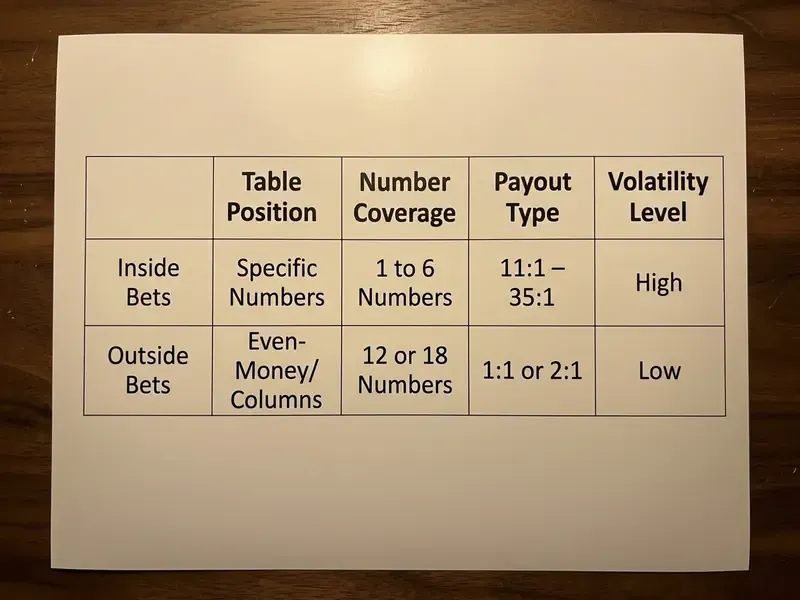
Inside bets vs outside bets: key differences at a glance
ParameterInside BetsOutside Bets
Coverage1 to 6 numbers per bet12 to 18 numbers per bet
Payout range5:1 to 35:11:1 to 2:1
VolatilityHighLow
Best forPlayers seeking larger single-spin winsPlayers seeking longer sessions and steadier results
House edge2.70% (European)2.70% (European)

The difference between inside and outside bets is purely one of volatility, not expected return. That is a point many beginners miss.

European, American and Live Roulette Variations

Not all roulette wheels are created equal. The variant you choose directly affects your expected loss per spin, and in some cases the rules offer mechanisms that cut the house edge further. This section covers the main roulette games and how modern online delivery formats add new dimensions to the experience.

European Roulette vs American Roulette

The single most important decision a roulette player can make is which variant to play. The difference is not cosmetic. It is mathematical:

FeatureEuropean RouletteAmerican Roulette
Pockets37 (1-36 + 0)38 (1-36 + 0 + 00)
House Edge2.70%5.26%
Straight-Up True Odds1 in 371 in 38
Payout (Straight-Up)35:135:1

The maths is straightforward. In European roulette the casino retains 1 out of every 37 units wagered on average (1/37 = 2.70%). In American roulette, the extra 00 pocket adds a second losing slot while payouts remain unchanged at 35:1, so the casino retains 2 out of every 38 units (2/38 = 5.26%). If both variants are available, always choose European roulette. The additional double-zero pocket in American roulette nearly doubles the casino's advantage without offering any compensating benefit to the player.

American roulette also features a unique "Five Bet" (also called the basket bet), covering 0, 00, 1, 2, and 3. This bet carries an even steeper house edge of 7.89%, making it the worst wager on any standard roulette table.

French Roulette uses the same 37-pocket wheel as European roulette, but introduces an important rule that further reduces the house edge on even-money bets:

  • La Partage: If you place an even-money bet (red/black, odd/even, high/low) and the ball lands on zero, you lose only half your stake instead of the full amount. This effectively halves the house edge on these bets to approximately 1.35%.
  • En Prison (variant): Some tables offer an alternative where your even-money bet is "imprisoned" when zero hits. If your bet wins on the next spin, you get the full stake back (but no winnings). If it loses, you forfeit the stake entirely.

For players who primarily make even-money bets, French roulette with La Partage offers the lowest house edge of any standard roulette variant. That is a genuine structural advantage, not a gimmick.

The maths is straightforward. In European

The Gambling Commission introduced a minimum 5-second interval between game cycles for online casino products (excluding slots), effective January 2025. - Gambling Commission, Online Game Design Changes Assessment, 2023-2024. https://www.gamblingcommission.gov.uk/licensees-and-businesses/guide/online-game-design

What to Expect from Roulette Live Dealer Games

Live dealer roulette bridges the gap between the convenience of online play and the atmosphere of a physical casino. A real dealer operates a real roulette wheel in a professional studio, and the action is streamed to players in real time via HD video. Players interact through a digital interface but watch an authentic physical outcome.

Key characteristics of live roulette include:

  • Real-time human interaction:Players can chat with the dealer and sometimes with other players.
  • Physical outcome determination:The result comes from a real wheel and ball, not a software algorithm (though cameras and optical character recognition technology record the result digitally).
  • Controlled pace:Rounds typically run on 30 to 60 second cycles, set by the dealer and studio workflow.
What to Expect from Roulette Live

A survey of 617 adult online casino players (September 2023) found that the majority considered current spin speeds "about right," with those who reported dissatisfaction more likely to say games were "too slow" rather than "too fast."

A survey of 617 adult online casino gamblers (September 2023) showed that most consider the current spin speed "optimal"; dissatisfied players more often described games as too slow. - Gambling Commission, Survey of Online Casino Gamblers, September 2023, n=617. https://www.gamblingcommission.gov.uk/statistics-and-research/publication/online-casino-game-design-consultation

The live casino sector has expanded far beyond a simple wheel and dealer. Providers like Evolution have introduced variants that merge traditional roulette with entertainment-show mechanics:

  • Lightning Roulette:In each round, one to five "Lucky Numbers" are struck by lightning and assigned randomly generated multipliers between 50x and 500x on straight-up bets. The game won Product Innovation of the Year at the Global Gaming Awards, G2E Las Vegas, and was voted EGR's Game of the Year 2018.
  • XXXtreme Lightning Roulette:Adds "Chain Lightning" that can generate up to nine additional multiplied numbers per round, with "Double Strike" multipliers pushing payouts up to 2,000x.
  • Immersive Roulette:Uses multiple camera angles and slow-motion replays of the ball settling into the pocket, creating a cinematic viewing experience.
  • Speed Roulette:Cuts round duration to approximately 25 seconds, about 50% faster than standard live roulette, by having players bet only during the spin.
  • Auto Roulette:Removes the human dealer entirely, using an automated precision wheel for faster, uninterrupted play. Available in European, French, and American configurations.
  • Double Ball Roulette:Two balls are launched from a patented device, delivering two winning numbers per spin and payouts up to 1,300:1.
Baji Live heading-banner

Pragmatic Play is another significant live-casino provider, offering its own range of localised roulette tables with multiple camera angles and native-language dealers.

Regulatory attention to online game speed has intensified. Following the introduction of spin-speed restrictions, data showed that the proportion of sessions lasting more than one hour decreased, while overall engagement with slot products increased over the same period. This suggests that some players may have shifted activity between product categories.

After the introduction of spin-speed restrictions, the share of sessions lasting more than one hour declined, while overall slot engagement increased. - Gambling Commission, Assessment of Online Game Design Changes, 2023-2024. https://www.gamblingcommission.gov.uk/licensees-and-businesses/guide/online-game-design

This finding is relevant for roulette players because it underlines that game speed is a meaningful factor in play intensity. Slower formats like live dealer tables may naturally encourage more measured play.

Roulette Demo, Free Play and Real Money Options

Most online casinos and game aggregators offer roulette in both demo (free-play) and real-money modes. The distinction matters not just financially but also psychologically and behaviourally.

When Roulette Demo Is the Better Choice

Free-play roulette serves several legitimate purposes:

  1. Interface testing: Demo mode lets you explore the game layout, button placement, bet controls, and feature flow without risking funds. This is especially useful when trying a new provider's software for the first time.
  2. Rule learning: If you are unfamiliar with how a specific variant works, for instance the La Partage rule in French roulette or the bonus multipliers in Lightning Roulette, demo mode allows unlimited experimentation.
  3. Strategy exploration: You can test different bet combinations and staking patterns to understand how they affect bankroll volatility, without any financial consequences. Outcomes in demo mode mirror the game's mathematical logic and RNG algorithms.
  4. Entertainment without risk: Some players simply enjoy the mechanics of roulette as a pastime, with no intention of wagering real money.

Roulette demo is available directly in the browser on most platforms, including on mobile devices, and typically requires no account registration. For anyone new to playing roulette, it is genuinely the smartest starting point.

Research increasingly suggests that simulated gambling (including demo casino games) can act as a gateway to real-money play for some individuals. A large explorative study (n=46,136) examined the relationship between simulated and real-money gambling among German adults.

Key findings:

  • 17% of the full sample and 54% of problem gamblers said they were "fairly sure" or "convinced" that simulated games had led them to gamble with real money.
  • 33% of participants who engaged in both simulated and real-money gambling showed problem-gambling indicators, compared to just 7% among those who gambled only with real money.
When Roulette Demo Is the Better

"17% of the entire sample and 54% of problem gamblers were 'fairly sure' or 'convinced' that simulated games led them to real-money gambling." - Explorative Study on Simulated and Real-Money Gambling, Journal of Gambling Studies, 2024, n=46,136. https://doi.org/10.1007/s10899-024-10300-8

Research on young people's pathways into gambling has revealed concerning patterns as well. A study by Russell et al. (2023) found that most simulated gambling products, except free loot boxes, were associated with higher Problem Gambling Severity Index (PGSI) scores and an increased likelihood of having experienced gambling problems.

"Most forms of simulated gambling, except free loot boxes, are associated with higher PGSI scores and increased likelihood of gambling problems." - Russell et al., 2023, International Journal of Behavioral Addictions. https://doi.org/10.1556/2006.2023.00020

What Changes in Real Money Roulette

The transition from demo to roulette real money is where the experience shifts fundamentally. The game mechanics stay the same. The maths stays the same. But the psychological weight of every spin changes completely.

A UTAUT3-based analysis (n=408) of young adults' intentions to gamble online found that perceived profitability outweighs perceived risk as a predictor of gambling intention, and that self-control has a surprisingly weak influence on the decision to play roulette for real money.

"A UTAUT3 analysis (n=408) showed perceived profitability outweighs perceived risk, and self-control weakly influences intention to gamble online." - UTAUT3 Study on Online Gambling Intention, Generation Z and Millennials, Philippines, 2024. https://doi.org/10.1016/j.heliyon.2024.e26541

This suggests that many young adults may view real-money gambling as an opportunity rather than a risk. That finding reinforces the importance of clear responsible-gambling messaging at the point of transition from demo to real-money play.

In practical terms, real money roulette demands:

  • Betting discipline:Setting a session budget before you start and sticking to it, no exceptions.
  • Awareness of limits:Both your personal financial limits and the table limits that constrain progressive strategies.
  • Emotional readiness:Losses feel different when real money is at stake. If frustration or anxiety creeps in, that is a signal to stop.
Baji Live heading-banner

Players exploring online casino platforms should be aware of this dynamic and approach the transition thoughtfully.

Disclaimer: Playing with real money carries financial risk. Demo mode outcomes do not predict real-money results. If you recognise signs of problem gambling, such as chasing losses, hiding play, or feeling anxious about gambling, seek help through national helplines or self-exclusion tools offered by licensed operators.

Roulette Odds, House Edge and What They Mean

Understanding the mathematics behind roulette is the single most effective way to set realistic expectations and avoid costly misconceptions. Let us break down the numbers and explain what they mean in practice.

Why Odds Change Between Roulette Variants

The house edge is the percentage of every unit wagered that the casino expects to retain over the long run. It exists because payouts are set slightly below the true mathematical odds:

European Roulette (single zero):

  • True odds of hitting a single number: 1 in 37
  • Payout: 35:1 (which implies 36:1 in total return including stake)
  • Expected return per unit: 36/37 = 0.9730
  • House edge: 1/37 = 2.70%
  • RTP (Return to Player): 97.30%

American Roulette (double zero):

  • True odds of hitting a single number: 1 in 38
  • Payout: 35:1 (still 36:1 total return)
  • Expected return per unit: 36/38 = 0.9474
  • House edge: 2/38 = 5.26%
  • RTP: 94.74%

French Roulette with La Partage (even-money bets):

  • House edge on even-money bets: approximately 1.35%
  • RTP on even-money bets: approximately 98.65%

House-edge figures can be converted into return-to-player (RTP) percentages by subtracting from 100%. In regulatory contexts, both figures are used. The Gambling Commission and other licensing authorities require operators to make these figures available to players, ensuring transparency in game fairness.

To put these figures in broader context: according to Gambling Commission data for the year to March 2023, online gambling participation in the UK stood at 26%, with a problem-gambling rate of 0.3%.

Why Odds Change Between Roulette Variants

"Online gambling participation was 26% and the problem gambling rate was 0.3% for the year to March 2023." - Gambling Commission, Gambling Participation and Problem Gambling Statistics, n=4,002. https://www.gamblingcommission.gov.uk/statistics-and-research/publication/gambling-participation-and-problem-gambling-statistics

Research on how house-edge information is communicated has shown that the format matters significantly. A randomised study of 3,333 participants found that an alternative house-edge framing produced the lowest perceived chances of winning, while the standard format yielded the highest rate of correct understanding.

"The alternative house-edge framing produced the lowest perceived win chances, while the standard format yielded the highest correct understanding." - Newall et al., 2023, randomised study, n=3,333, Psychiatry Research. https://doi.org/10.1016/j.psychres.2023.115440

Here is the complete roulette odds table for every standard bet:

BetNumbers CoveredPayoutEuropean Win ProbabilityAmerican Win Probability
Straight Up135:12.70%2.63%
Split217:15.41%5.26%
Street311:18.11%7.89%
Corner48:110.81%10.53%
Six Line65:116.22%15.79%
Dozens122:132.43%31.58%
Columns122:132.43%31.58%
Red/Black181:148.65%47.37%
Odd/Even181:148.65%47.37%
High/Low181:148.65%47.37%

Every single bet on the European wheel carries the same 2.70% house edge (with the exception of French roulette La Partage bets at 1.35%). On the American wheel, every bet carries 5.26% except the Five Bet at 7.89%.

Best Bets for Lower-Risk Roulette Play

For players seeking to minimise bankroll volatility and extend session length, outside even-money bets (red/black, odd/even, high/low) on a European or French table are the most commonly recommended approach. These bets:

  • Cover 18 of 37 numbers (48.65% win rate)
  • Pay 1:1, meaning frequent small wins that offset losses
  • Produce the lowest variance of any standard wager
  • On a French table with La Partage, carry only a 1.35% house edge

However, lower volatility does not mean lower expected loss in the long run. The house edge ensures that over thousands of spins, the casino retains its percentage regardless of bet type. What changes is the experience: outside bets produce a smoother, more predictable session, while inside bets create dramatic swings.

Best Bets for Lower-Risk Roulette Play

"High play frequency, high expenditure, and participation in multiple online gambling activities are associated with elevated levels of gambling-related problems." - E-GAMES Project, Journal of Gambling Studies, 2023, five European countries. https://doi.org/10.1007/s10899-023-10200-7

This finding from a multinational European study reinforces that the volume and frequency of play matter at least as much as bet selection when it comes to gambling-related harm.

Roulette Strategy: What Helps and What to Avoid

The word "strategy" in roulette requires a careful definition. Unlike poker or blackjack, where player decisions can meaningfully affect expected value, roulette offers no such opportunity. The house edge is fixed by the wheel's structure and the payout schedule. What strategies can do is help you manage your bankroll, structure your sessions, and set rules for when to walk away. What they cannot do is change the mathematical odds.

Let me be direct about this: if someone tells you they have a roulette strategy that beats the house, they are either confused or selling something.

Progressive and Non-Progressive Betting Strategies

Betting strategies fall into two broad categories:

Progressive strategies require you to change your bet size based on previous outcomes, typically increasing after a loss (negative progression) or after a win (positive progression). They carry higher bankroll risk and can be stopped dead by table limits.

Non-progressive strategies keep your bet size constant. They offer more predictable bankroll depletion and are better suited for players with limited funds or conservative risk tolerance.

The Martingale System

The most famous negative-progression system: double your bet after every loss on an even-money wager. The logic is that one win will recover all previous losses plus a profit equal to the original stake.

Simulation: Starting with $2 on red/black

SpinBetOutcomeCumulative Result
1$2Loss-$2
2$4Loss-$6
3$8Loss-$14
4$16Loss-$30
5$32Loss-$62
6$64Loss-$126
7$128Loss-$254
8$256Win+$2

After seven consecutive losses and a win on spin 8, the net profit is just $2, the original stake. But the player needed $510 in cumulative wagers to achieve it. A ninth consecutive loss would require a $512 bet, which many tables would not allow (typical maximum bets range from $500 to $1,000 on even-money wagers). The Martingale does not change the house edge; it merely reorganises when losses occur.

The Grand Martingale

A more aggressive variant: after each loss, double the bet and add one base unit. This accelerates both potential recovery and potential ruin:

SpinBetOutcome
1$1Loss
2$3Loss
3$7Loss
4$15Loss
5$31Loss
6$63Loss
7$127Loss
8$255Loss

By spin 8, total losses exceed $500, and the required bet for spin 9 surpasses most table limits.

The D'Alembert System

A gentler negative progression: increase your bet by one unit after a loss, decrease by one unit after a win. It climbs more slowly than Martingale and retreats after wins, making it less volatile.

Example (base unit = $10):

SpinBetOutcomeNext Bet
1$10Loss$20
2$20Loss$30
3$30Win$20
4$20Win$10
5$10Loss$20

The D'Alembert works best in roughly balanced win/loss streaks and is less risky than systems that escalate geometrically. It remains popular among cautious players seeking a slower, steadier approach. Still, it does not eliminate the house edge.

The Fibonacci System

Based on the famous sequence (1, 1, 2, 3, 5, 8, 13, 21...), you move one step forward after a loss and two steps back after a win. It spreads risk more gently than the Martingale:

Example (unit = $10):

SpinSequence PositionBetOutcome
11$10Loss
22$10Loss
33$20Loss
44$30Win, back 2
52$10Win, back 2
61$10Continue

This system can extend playing time and recover losses more gradually, but like all progressive systems, a long losing streak will eventually push bets to uncomfortable or table-limited levels.

The Paroli (Reverse Martingale) System

A positive-progression system: double your bet after a win, reset to the base after a loss or after three consecutive wins. The goal is to capitalise on short winning streaks while limiting losses to the base bet during cold runs.

SpinBetOutcomeProfit Running Total
1$1Win+$1
2$2Win+$3
3$4Win+$7, Reset
4$1Loss+$6
5$1Loss+$5
6$1Win+$6

The Paroli is considered one of the safer progressive systems because it limits upside chasing to three steps and never requires betting more than the base amount after a loss.

The James Bond Strategy

This non-progressive approach covers a large portion of the roulette table in a single spin using a fixed $200 stake split as follows:

  • $140 on high numbers (19-36) covers 18 numbers
  • $50 on the six-line 13-18 covers 6 numbers
  • $10 on zero serves as insurance against 0

You win on 25 out of 37 numbers (67.6%). You lose only if numbers 1 to 12 hit, but when they do, you lose the full $200. The James Bond strategy does not alter the house edge; it simply concentrates losses into a narrower band of outcomes.

Common Roulette Myths and Risky Systems

The Gambler's Fallacy

The most pervasive and dangerous misconception in roulette: the belief that past outcomes influence future ones. "Red has come up ten times in a row, black must be due!" In reality, each spin is a completely independent event. The ball and the wheel have no memory.

Mathematical proof: In European roulette, P(red) = 18/37 = 48.65% on every single spin, regardless of what happened on the previous 10, 100, or 1,000 spins. The conditional probability is identical to the unconditional probability:

P(Red on spin 11 | 10 consecutive Reds) = 18/37 = 48.65%

Chasing "due" outcomes leads to overbetting, frustration, and major losses. Understanding that each spin is random helps you play roulette with clearer expectations and avoid chasing patterns that simply do not exist.

"Hot Table" and "Cold Table" Myths

Streaks are a natural and expected feature of random sequences. A run of 10 reds in a row on a European wheel has a probability of approximately (18/37)^10, roughly 0.07%. Rare, yes. But inevitable over thousands of sessions. The streak does not make the table "hot" or "due to cool." It is simply a sample from an independent process.

"Guaranteed Win" Systems Sold Online

Systems marketed as "foolproof" or "guaranteed" methods for beating roulette are among the biggest scams in the gambling world. These so-called methods typically recycle basic strategies like Martingale or Fibonacci, dress them in impressive-sounding language, and charge a fee. The truth: no system can beat the house edge.

"The Gambling Commission emphasises that gambling is designed so that most players lose money, and only a portion of stakes is returned as winnings." - Gambling Commission, Gambling Participation and Problem Gambling Statistics, year to March 2023. https://www.gamblingcommission.gov.uk/statistics-and-research/publication/gambling-participation-and-problem-gambling-statistics

Classic empirical research on casino behaviour has documented that players raise stakes on perceived streaks even though outcomes are independent and the probability of each result is fixed. This interaction between progressive betting systems and cognitive biases, such as the gambler's fallacy and hot-hand illusion, amplifies the risk of substantial losses.

Fact-Checking the Claim: "How to Win at Roulette Every Time"

This phrase appears in thousands of search queries every month. The honest answer is simple: you cannot win at roulette every time. The house edge is a structural feature of the game, not a problem to be solved. Any strategy that promises consistent or guaranteed wins is either misinformed or dishonest.

What informed players can do:

  1. Choose European or French roulette over American to minimise the house edge.
  2. Use even-money bets on French tables with La Partage for the lowest possible edge (1.35%).
  3. Set loss limits and win targets before each session and stick to them.
  4. Treat roulette as entertainment, not as an income source.
  5. Understand variance: short-term results can deviate significantly from the expected average. A winning session does not mean you have beaten the game; it means variance temporarily worked in your favour.
Fact-Checking the Claim How to Win

"33% of players who engage in both simulated and real-money gambling show problem-gambling indicators, compared to 7% among those who gamble only with real money." - Explorative Study on Simulated and Real-Money Gambling, Journal of Gambling Studies, 2024, n=46,136. https://doi.org/10.1007/s10899-024-10300-8

This suggests that prolonged play across products exposes players to the cumulative effects of house edge and cognitive biases.

How to Choose the Best Roulette Online Experience

With dozens of providers, formats, and platforms available, selecting the right roulette experience depends on your goals, budget, and risk tolerance. Here is a structured framework for making that choice.

Best Choice for Beginners, Practice and Live Play

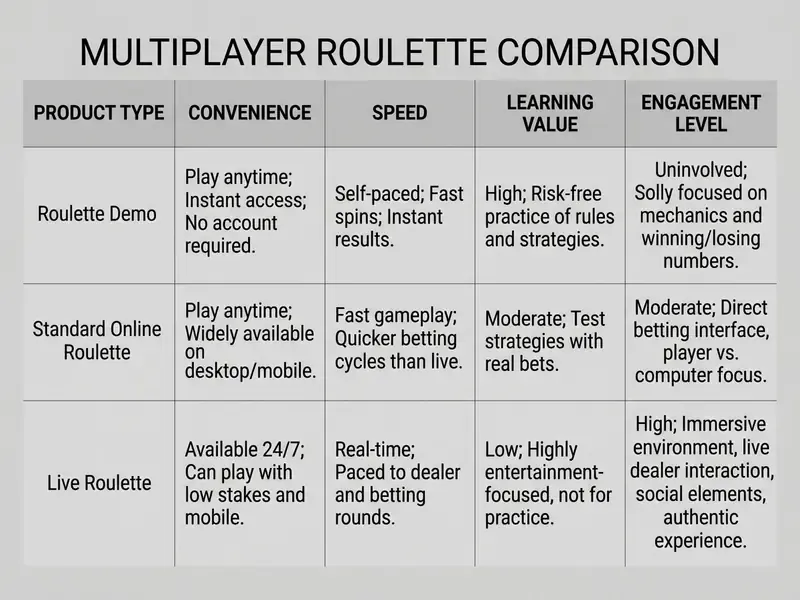
ParameterDemo / Free PlayRNG Online (Real Money)Live Dealer (Real Money)
Financial riskNoneYes, real stakesYes, real stakes
Time per betUnlimitedFast (typically 5-15 seconds)Moderate (30-60 seconds per round)
ImmersionLow (software graphics)Medium (polished UI, sound effects)High (real dealer, physical wheel, HD video)
Social interactionNoneNone or minimal chatLive chat with dealer and players
Best forLearning rules, testing interfacesConvenient, fast sessionsAtmosphere, trust in physical outcomes
RNG/PhysicalSoftware RNGSoftware RNGPhysical wheel + live stream

Players exploring licensed online casinos should look for operators regulated by recognised authorities such as the UK Gambling Commission, the Malta Gaming Authority (MGA), or equivalent bodies in their jurisdiction. Licensing ensures that games are independently tested for fairness and that player protection mechanisms are in place.

If you are brand new to roulette:

  1. Start with roulette demo mode on a European roulette table to learn the interface, bet types, and payout mechanics without financial risk.
  2. Experiment with different bet combinations. Try inside bets, outside bets, and mixed approaches to understand how they affect the pace and feel of the game.
  3. Move to low-stakes RNG European roulette when you feel comfortable with the rules. Set a strict loss limit, perhaps $20 to $50 for your first real-money session.
  4. Progress to live dealer European roulette only after you are fully comfortable with betting mechanics and bankroll management.

If you are an experienced player:

  • Prioritise French roulette with La Partage for even-money bets (1.35% edge).
  • Consider Lightning Roulette if you enjoy high-multiplier excitement on straight-up bets, but be aware that the base straight-up payout is reduced to 29:1 (the multipliers compensate on selected numbers).
  • Use responsible gambling tools: deposit limits, session timers, and loss limits, which have been shown in some studies and policy evaluations to modestly influence attitudes, perceived control, and gaming behaviour.
Players exploring licensed online casinos should

"Responsible gaming policy significantly influences attitudes, subjective norms, and perceived control, indirectly reducing gaming behaviour." - Macao Study on Responsible Gaming Policy, 2024, n=644. https://doi.org/10.1016/j.tourman.2024.104900

Caution for younger players: Research using the UTAUT3 model found that social influence and perceived profitability are the strongest predictors of intention to gamble online among young adults, while self-control is not a significant factor.

"Social influence and perceived profitability are key predictors of online gambling intention; self-control does not significantly influence the decision." - UTAUT3 Study, Philippines, 2024, n=408. https://doi.org/10.1016/j.heliyon.2024.e26541

This means that for individuals who are susceptible to social or peer influence, live roulette in a live casino environment may pose heightened risk and should be approached with particular caution or avoided.

Key Criteria for Selecting an Online Roulette Platform

When evaluating where to play roulette online, consider these five factors:

  1. Licensing and regulation: Is the operator licensed by a reputable authority (UKGC, MGA, Curacao eGaming, etc.)? Licensing ensures game fairness audits, player fund segregation, and access to dispute resolution.
  2. Game variant availability: Does the platform offer European and French roulette? Avoid platforms that only feature American roulette.
  3. Betting limits: Do the minimum and maximum bets suit your bankroll and intended strategy? Progressive strategies in particular require headroom above the minimum.
  4. Responsible gambling tools: Does the platform offer deposit limits, session reminders, loss limits, reality checks, and self-exclusion options?
  5. Provider reputation: Are the roulette games supplied by established providers (Evolution, Pragmatic Play, Playtech) with transparent RTP information?
Key Criteria for Selecting an Online

Online gambling legality varies significantly by jurisdiction, each with its own age restrictions, licensing requirements, and harm-minimisation policies. In Bangladesh, for instance, gambling laws are restrictive, and players should carefully verify what is permitted before engaging with any roulette casino platform. Players everywhere are responsible for ensuring that online gambling is legal in their location before wagering real money.

To put the market in perspective: Gambling Commission data shows a four-week gambling participation rate of 44%, with online participation at 26%, and a problem gambling rate of 0.3%.

Regulatory, Legal Considerations and Responsible Play

Responsible gambling is not a passive concept. It requires active engagement with the tools available. Research from Macao found that the indirect effect of responsible gaming policy on gaming behaviour is statistically significant and negative, though modest in magnitude, reinforcing that these tools work but require individual commitment.

Core responsible-play principles:

  • Set a budget before each session and never exceed it.
  • Set a time limit and use session reminders if your platform offers them.
  • Never chase losses. If you have hit your loss limit, stop.
  • Do not gamble under the influence of alcohol or emotional distress.
  • Use self-exclusion if gambling stops being enjoyable.

If you or someone you know needs help, contact BeGambleAware (begambleaware.org), GamCare (gamcare.org.uk), or the National Council on Problem Gambling (ncpgambling.org).

Conclusion

Roulette is a beautifully simple game with a clearly defined mathematical structure. The house edge, 2.70% for European, 5.26% for American, and as low as 1.35% for French roulette with La Partage, is embedded in the payout schedule and cannot be altered by any betting system. Making the choice of variant and table rules is one of the few structural decisions that can genuinely reduce expected loss, making it one of the most important considerations for any player in the broader online casino industry.

Betting strategies like the Martingale, D'Alembert, Fibonacci, and Paroli can shape the experience, smoothing out volatility, structuring sessions, and providing a framework for discipline. But none of them changes the underlying odds. The most dangerous error a player can make is believing otherwise.

The evidence from multiple research studies reinforces key points:

  • Demo and simulated gambling can be educational but also act as gateways to real-money play.
  • Cognitive biases like the gambler's fallacy lead to irrational bet adjustments.
  • Responsible gambling tools have a real, if modest, effect on behaviour.
  • High-frequency, multi-product play is associated with elevated gambling-related harm.
Conclusion. Roulette is a beautifully simple

"Data from the E-GAMES project across five European countries confirm that high online play frequency and participation in multiple activities are associated with elevated levels of gambling problems." - E-GAMES Project, Journal of Gambling Studies, 2023. https://doi.org/10.1007/s10899-023-10200-7

Play roulette for what it is: entertainment with a cost. Understand the odds, use the tools available, choose European or French tables, set your limits, and enjoy the spin.

FAQ About Roulette Online

What is the best bet in roulette for beginners?

Outside even-money bets, such as red/black, odd/even, or high/low, are the safest starting point. They win close to 50% of the time (48.65% on a European wheel) and produce the lowest volatility of any standard wager. On a French table with La Partage, the house edge on these bets drops to just 1.35%.

Is it possible to consistently win at roulette?

No. The house edge means the casino retains a percentage of every bet over the long run. Short-term wins are possible due to variance, but no roulette strategy, system, or pattern can overcome the mathematical advantage built into the game.

Should I avoid American roulette?

Yes, whenever European or French roulette is available. The double zero in American roulette nearly doubles the house edge from 2.70% to 5.26% without offering any compensating advantage to the player.

How does the Martingale system work, and is it safe?

The Martingale requires you to double your bet after every loss on an even-money wager. A single win recovers all previous losses plus a one-unit profit. The risk: a losing streak of 7 to 8 spins can push required bets past $250 to $500, hitting table limits and eliminating the ability to continue the sequence. The system does not change the house edge.

What is Lightning Roulette and how does it differ from regular roulette?

Lightning Roulette is a live-dealer roulette game by Evolution that adds randomly generated multipliers (50x to 500x) to one to five "Lucky Numbers" each round. The base straight-up payout is reduced from 35:1 to 29:1, with the multipliers compensating on selected numbers. It offers a more volatile, entertainment-focused experience compared to standard roulette.

Can roulette demo help before playing with real money?

Yes. Most online casinos and game aggregators offer demo or free-play versions of roulette. Demo mode uses the same RNG and game logic as the real-money version, allowing you to learn rules, test bet types, and explore interfaces without financial risk. However, research suggests that simulated play can act as a gateway to real-money gambling for some users, so approach the transition thoughtfully.

What does a roulette live dealer session actually look like?

In a roulette live dealer session, you watch a real croupier spin a physical wheel in a professional studio via HD video stream. You place bets through a digital interface on your screen, but the outcome is determined by the physical ball landing in a real pocket. Most rounds last 30 to 60 seconds, and you can chat with the dealer in real time. It is the closest online experience to sitting at a casino table.